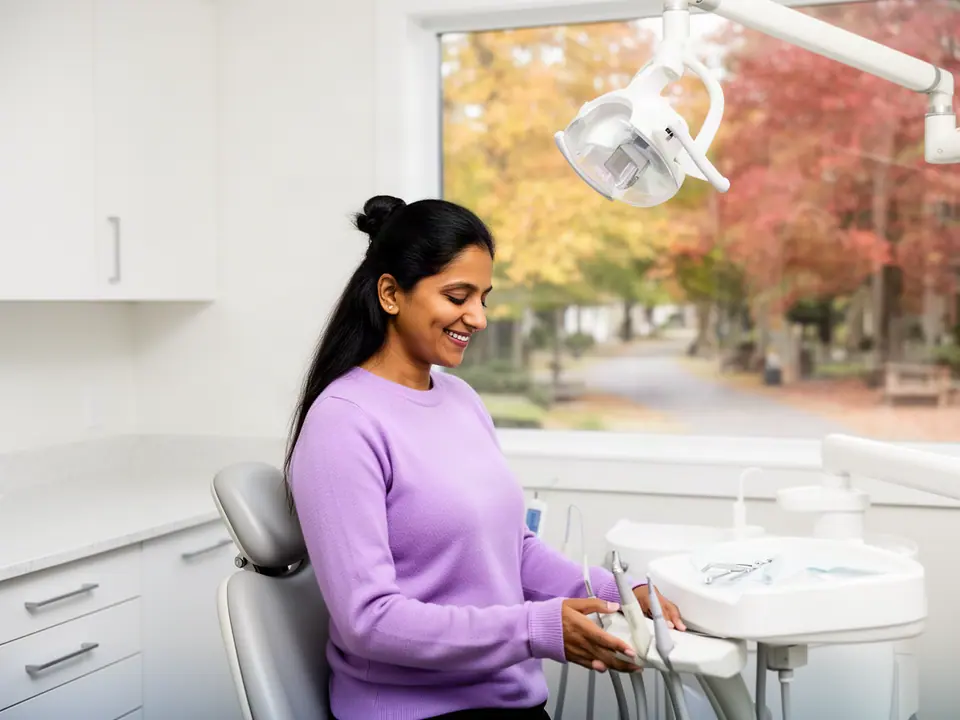
A second classroom at an operating Columbia, MD child care center needs movable furniture and learning equipment, plus teachers before enrollment covers them. A daycare loan request can split those costs, with equipment financing for cribs, indoor learning equipment or cots and working capital for the payroll gap. Minthollow Financial forwards the request to funding partners, which can weigh each component separately.
Movable classroom and learning equipment plus payroll gaps for Columbia, MD child care centers.
Adding a classroom or an infant room in a Columbia, MD center
A second room needs furniture and supplies before teachers can use it. Fixed walls, flooring, sinks, lighting and doors are outside this request. Movable cribs, changing tables, food-prep appliances and classroom supplies can be listed on a supplier quote.
Child day care is a substantial employer in Howard County, MD. County Business Patterns counted 115 child day care establishments with paid staff in 2023, with 1,951 employees between them: about 17.0 per center and $31,390 of payroll per worker, in our arithmetic. Of the 115 employers, 37 had fewer than five employees; the remaining 78, or 67.8%, had five or more. ZIP 21044, which lies mostly inside Columbia, MD but covers only about a third of its land, held 15 child day care employers (ZBP 2023).
The daycare centers page has the rest of the county figures, including the 539 child care businesses without paid employees counted in the 2024 Nonemployer Statistics.
Indoor learning equipment, cribs and cots as financed equipment
Much of what a new room needs can be financed as equipment, with the items themselves as collateral. Each piece should be on a vendor quote, with installation listed separately.
- Soft-play climbers, activity mats and sensory tables; playground structures, shade sails and permanent surfacing are property work outside this site.
- Cribs, cots, changing stations and classroom furniture.
- Kitchen equipment for a center that prepares meals.
- Cots and bedding racks for nap rooms.
- Security camera kits and check-in tablets; wired entry systems are excluded.
Terms matched to how long each item lasts are explained on the equipment financing page. Fixed walls, plumbing and permanent surfacing are outside this request; the supplier quote identifies each movable item.
Covering staff payroll while enrollment fills a new room
Teachers have to be hired and trained before the room opens, and a new room may not fill on day one. That part of an expansion is easy to underestimate.
Illustration only, invented figures: an infant room for 8 children, at $2,150 a month in tuition, needs 3 teachers costing $4,100 a month each with taxes, plus $600 of supplies: $12,900 a month. Hiring 30 days ahead means 2 or 3 biweekly paydays of about $5,677 each before any child arrives. Enrollment then fills over six months:
| Month | Infants enrolled | Tuition | Against $12,900 of costs |
|---|---|---|---|
| Month 1 | 2 of 8 | $4,300 | $8,600 short |
| Month 2 | 3 of 8 | $6,450 | $6,450 short |
| Month 3 | 5 of 8 | $10,750 | $2,150 short |
| Month 4 | 6 of 8 | $12,900 | break-even |
| Month 5 | 7 of 8 | $15,050 | $2,150 ahead |
| Month 6 | 8 of 8 | $17,200 | $4,300 ahead |
The three months that run short come to $17,200. The pre-opening payrolls add $11,354 to $17,031, so the gap to cover is $28,554 to $34,231. That range is the figure for a working capital request, made before the room opens rather than when the account runs low. A center that already has a line of credit can draw on it instead; a center without one can ask a partner for one alongside the equipment request, so the room has its furniture and its first months of payroll arranged together.
Two cautions on the invented table. Tuition comes in only for enrolled children, so a family that delays a start date pushes the break-even month back. And a room that fills in two months instead of six shrinks the gap, which is a reason to size the request on the waiting list the center actually has, not on the room's capacity.
Lease, enrollment and operating records a funding partner can review for a Howard County, MD center
Each funding partner decides which records it will review: enrollment, financial statements and equipment quotes. This page does not interpret licensing rules; the center handles those with its own advisers.
- Current operating and enrollment records, plus any documentation a partner requests for the new room.
- The lease and any landlord consent required for equipment setup.
- Enrollment by room for the last 12 months, and the waiting list for the age group the new room serves.
- The tuition schedule, and how much revenue comes from subsidy or employer programs.
- Payroll reports and the staffing plan for the new room.
- Supplier quotes for movable classroom and learning equipment.
The center's own advisers handle licensing and capacity questions; the funding review can focus on operating records and supplier quotes. When the file is ready, the request form takes the details. Other articles are on the blog.
By Minthollow Financial · Updated